Me vs. ProWritingAid
This morning, I made a terrible mistake: I ran two ProWritingAid reports back-to-back.
If you’ve never done this, imagine getting a standing ovation and a slap across the face in the same ten seconds. That’s the vibe.
I started with the Virtual Beta Reader report for Countess of Cons, which basically sent me a Valentine. It loved my structure, loved my pacing, loved my emotional arc.
“Deb, darling, don’t change a single thing.”
I ate a cookie from last night’s Thanksgiving dinner to celebrate.
Then, I opened the Manuscript Analysis Report, the technical older sibling who wears sensible shoes and hates joy.
And—because the universe enjoys slapstick—I got the whiplash.
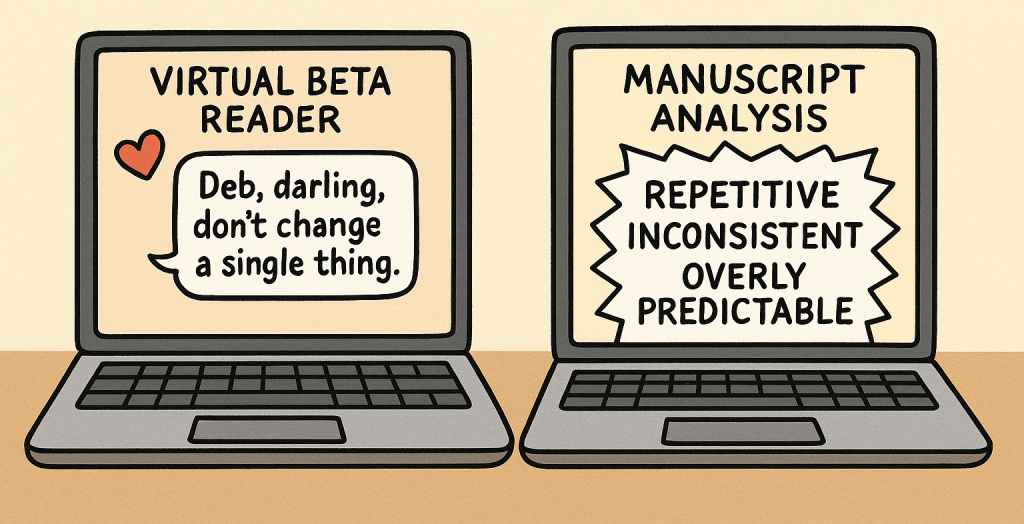
Suddenly this same manuscript—the one I’ve been sculpting like Michelangelo chipping away at a block of Gilded Age grift—apparently suffers from:
- repetitive courtroom scenes,
- inconsistent timelines,
- and Catherine’s crimes falling into an “overly predictable behavioral cycle.”
I haven’t seen a pivot that sharp since my GPS told me to “make a U-turn” while I was on a bridge on the way to Niagara Falls.
Better yet? Most of the “major flaws” it flagged weren’t narrative problems—they were history. You know, the thing I’m not allowed to rewrite just to soothe a cranky algorithm.
Catherine really was arrested a lot.
Trials really did pile up.
“Yet another legal proceeding” wasn’t my doing—Catherine racked them up like souvenirs.
This is like telling a Marie Curie biographer, “All this science feels repetitive. Have you thought about adding a love triangle?”
After thirty seconds of indignation (and another cookie), I did what any sensible writer would do: I marched back to the glowing Virtual Beta Reader report—the one that actually behaves like a human—and announced:
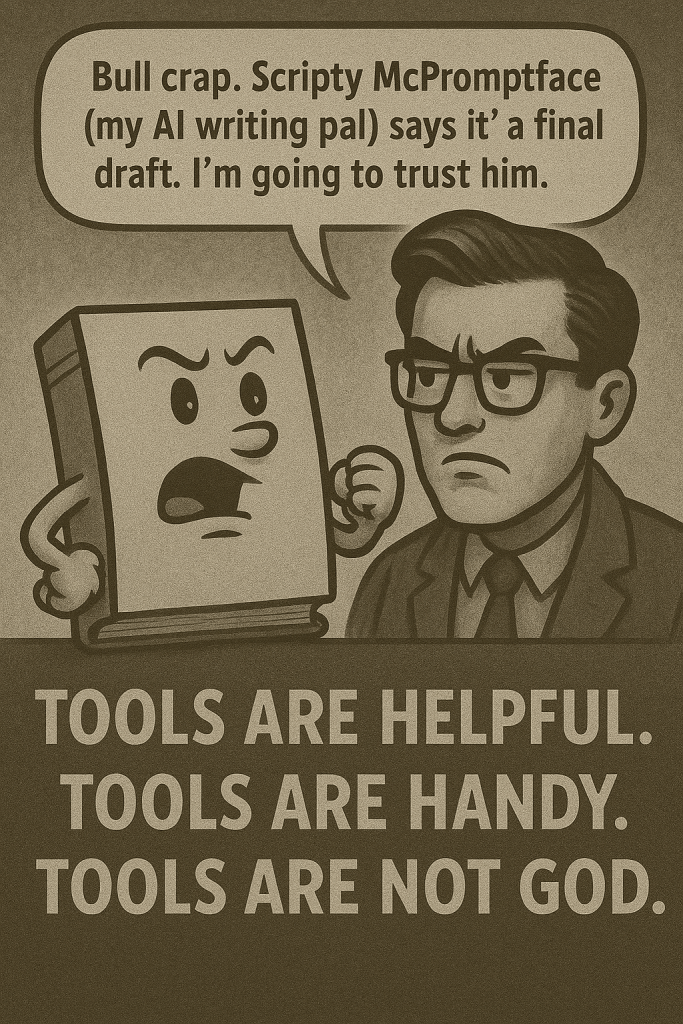
“Bull crap. Scripty McPromptface (my AI writing pal) says it’s a final draft. I’m going to trust him.”
Because here’s the truth most writers don’t say out loud:
Tools are helpful. Tools are handy. Tools are not God.
What the Manuscript Report Is Actually Good For
To be fair, the Manuscript Report isn’t pure villainy. It can be helpful—in a “helpful but doesn’t understand real life” sort of way.
Its true superpower?
Pointing out places where a reader might pause, squint, and think, Wait… what just happened?
Not because the story is broken.
But because even the best books have a few spots where the pacing hiccups or the transition takes a tiny leap of faith.
Think of the report as saying:
“Hey, maybe reread this section with fresh eyes.”
Not:
“Burn it all down and start over, you literary gremlin.”
The problem—and it’s a big one—is that the report assumes every life story behaves like a Netflix original:
- events rearranged for maximum drama,
- characters rewritten for neat arcs,
- and absolutely no one getting arrested more than once.
Meanwhile, I’m over here working with:
- court transcripts,
- old newspaper clippings,
- real train schedules,
- actual crimes and schemes,
- and a woman who never once consulted a modern story structure chart before ruining her own life.
Of course it noticed Catherine repeats behavior. She was a recidivist con artist, not a student at the Iowa Writers’ Workshop.
So yes, the report can point out a few rough spots worth smoothing.
But it cannot—and should not—dictate the shape of a story grounded in real history.
A Few Places the Robot Wasn’t Totally Wrong
It nudged me to consider a few things:
- Add one or two additional interior beats about Catherine’s mental lapses. Maybe.
- Add a sentence clarifying why Whitmer appealed. No, thank you.
- Remove a duplicated paragraph? Good catch. Done.
And the rest?
Straight into the IGNORE pile:
- “Too many newspapers.” (They are literally historical sources.)
- “Remove Ida’s lawsuit entirely.” (Absolutely not. This is her whole arc.)
- “Combine all reporters into one obsessed guy.” (This is not His Girl Friday.)
- “Make every twist less predictable.” (Biographical fiction, not Knives Out 3: Victorian Fraud Edition.)
The Emotional Whiplash? Totally Normal.
Sequence matters:
- First report: “This is gripping, emotionally powerful, and I couldn’t put it down.”
- Second report: “Here are 37 ways this could be more like our template for a hypothetical thriller you didn’t write.”
Of course it felt like an ambush.
Had I read the reports in the reverse order, there’s a very real chance I would’ve eaten the entire tray of leftover apple pie and Italian pastries in one sitting.
But here’s where I landed—and it may be the sanest decision I’ve ever made in my writing life:
Scripty McPromptface declared it a final draft.
I choose to believe him.
Final draft doesn’t mean “perfect.”
It means:
- Structure works.
- Emotional spine works.
- Ending lands.
- Reader experience is strong.
- Remaining tweaks are microscopic, not existential.
From here on out, we are proofreading—not rewriting Kansas City jurisprudence to soothe a fussy robot.
The Moral of the Story
ProWritingAid can help me polish a chapter.
It does not get a vote on whether the book is done.
ProWritingAid did its job.
I did mine.

And now this book is officially out of revision hell and marching toward publication.
And before I shut the lid on this circus for the day, let me say this:
If you’re a writer — fiction, nonfiction, creative nonfiction, grocery lists, ransom notes, whatever — please remember:
AI reports are assistants, not authorities.
They don’t know your life.
They don’t know your characters.
They don’t know the archival rabbit holes you crawled through, the court documents you squinted at, the 1890s newspapers that gave you eye floaters.
They certainly don’t know why your timeline is structured the way it is or why your protagonist committed the same crime eight slightly different ways.
A tool can flag a thing.
It cannot understand a thing.
So if you ever find yourself whiplashed between “This is brilliant!” and “Ma’am, please burn this and start fresh,” do what I did:
Take a breath.
Eat a cookie.
Ask yourself whether the criticism applies to your book, not an imaginary book the algorithm wishes you had written.
And then — this is the important part —
talk to real humans about it.
Tell me in the comments:
Have you ever gotten AI feedback that made you laugh, cry, scream, or question your life choices?
Did a report ever insist your historically accurate content “felt unrealistic”?
Did it ever hallucinate entire suggestions, characters, or subplots? (I once had a tool ask where “the dog” went. There is no dog.)
Drop your stories. We can form a support group.
Possibly with snacks.
Because yes — tools are helpful.
Tools are handy.
But they are absolutely not God.

 deborahsholman.com
Leave a comment