Remember that song, “Video Killed the Radio Star?” (If you don’t then I’m pretty pleased—that means younger people are reading my blog!!)
Lately, while editing Countess of Cons with Scripty McPromptface in the room, that song has been looping in my head. Because the way MTV changed music in the 1980s—suddenly it wasn’t just the song, it was the whole performance—feels uncomfortably similar to what AI is doing to writing in the 2020s.
And yes, it’s complicated.
Here’s what happened, what I learned, and the fix I’m trying next—because I refuse to let “polished” turn into “personality-free.
Like any relationship, there are ebbs and flows. Highs and lows.
Last Thursday was a low. I’d just read beta reader feedback and—after a long stint with my head in the sand—I had to admit the newest revision (the one I happily declared the FINAL DRAFT) was… boring.
Not badly written. Not messy. Just competent and completely joyless.
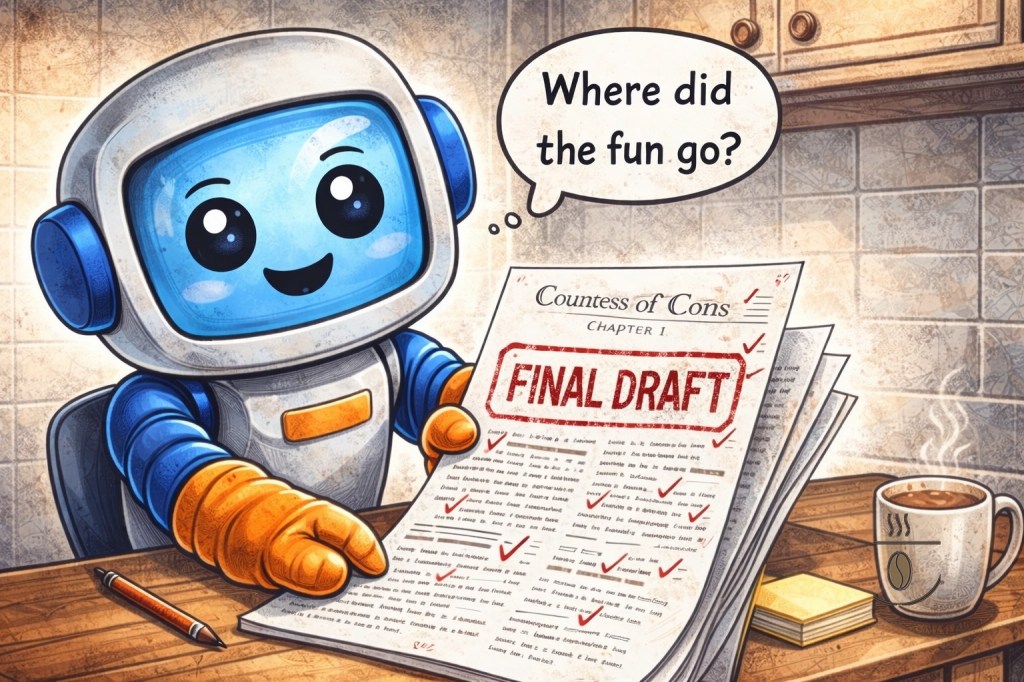
What happened is both simple and maddening: I did what I thought I was supposed to do. I followed my writing coach’s advice. I applied the rules of “good writing.” I revised carefully and methodically. Scripty (my AI pal) and I even built a routine: he’d “read” each chapter and critique it across the areas I requested, I’d revise accordingly, and we’d move on.
And somewhere in that efficient little system, I edited my own voice right out of the manuscript.
I love Catherine (the protagonist in Countess of Cons). She was strong and stubborn and snarky in all the ways an unmarried 50-year-old woman committing crimes across the Midwest in the 1890s needed to be. But in this version, the wry humor had been drained out. It read like a neat, orderly list of crimes—minus the spark that made me want to tell her story in the first place.
I was discouraged enough to consider quitting.
So, I did the sensible thing: I brought it to my writing group, the Daily Sprinters—who have talked me off ledges more than once. We talked about over-editing, over-relying on AI, and the sneaky way “improvement” can turn into over-correction. By the time we were done, I didn’t feel magically cured—but I did feel steady enough to try something practical instead of dramatic.
I ran an experiment.
The Experiment (a.k.a. Me Testing Whether I’d Edited the Fun Out of My Own Book)
I uploaded three versions of Chapter 1 to Scripty:
- Piece #1: the current revision (the so-called Final Draft — the most “editorially assisted”)
- Piece #2: the first revision after my developmental editor’s suggestions
- Piece #3: my original draft, before anyone else got their well-meaning hands on it
Then I asked three questions.
The Results (direct quotes from Scripty)
1) Which one sounds most like me?
Piece #1. It has my “controlled wit”—sharp, observant, a little dangerous, and not mugging for the reader.
Runner-up: Piece #3, because it has more obvious snark (and more “Deb-in-the-room” energy)… but it also slips into modern phrasing that doesn’t feel 1887.
2) Which one is the best written (craft-wise)?
Piece #1, again. Tighter, cleaner, more controlled. It trusts the reader.
Piece #2 was close, but it sometimes got a little writerly—polishing moments that were already doing their job.
Piece #3 was the least polished: more telling, more generalized description, and a few lines that pulled attention away from the tension.
3) Which one is the most fun to read?
Piece #3. No contest. More party-room electricity. More social bite. More mean-girl commentary. More movement.
But—there’s a catch: that’s also where the modernisms creep in. It’s fun… and it risks breaking the period spell.
So basically, the version with the most spark also had the most modern phrasing—fun, but risky in historical fiction.
I sat there blinking at the screen like it had personally betrayed me.
Apparently, I’d made the book “better.” I’d also made it less… Catherine.
Which is when I complained to Scripty: I think I’ve over-edited this. What do I do now?
And then, because Scripty has no bedside manner, he said
“This is the classic manuscript glow-up that accidentally sandblasts the personality.”
He broke it down like this: my original draft had the spark, my middle draft tightened the logic, and my final draft became the most professional… and the most restrained. Not because it was “bad,” but because I solved problems by quieting the voice instead of channeling it.
His advice surprised me: don’t revert. Use the current draft as the base and do a voice pass.
Honestly, that made me feel better. Reverting to the original is how you end up doing archaeological digs instead of finishing a book.
What I’m Doing Next: A Quick “Voice Salvage Pass”
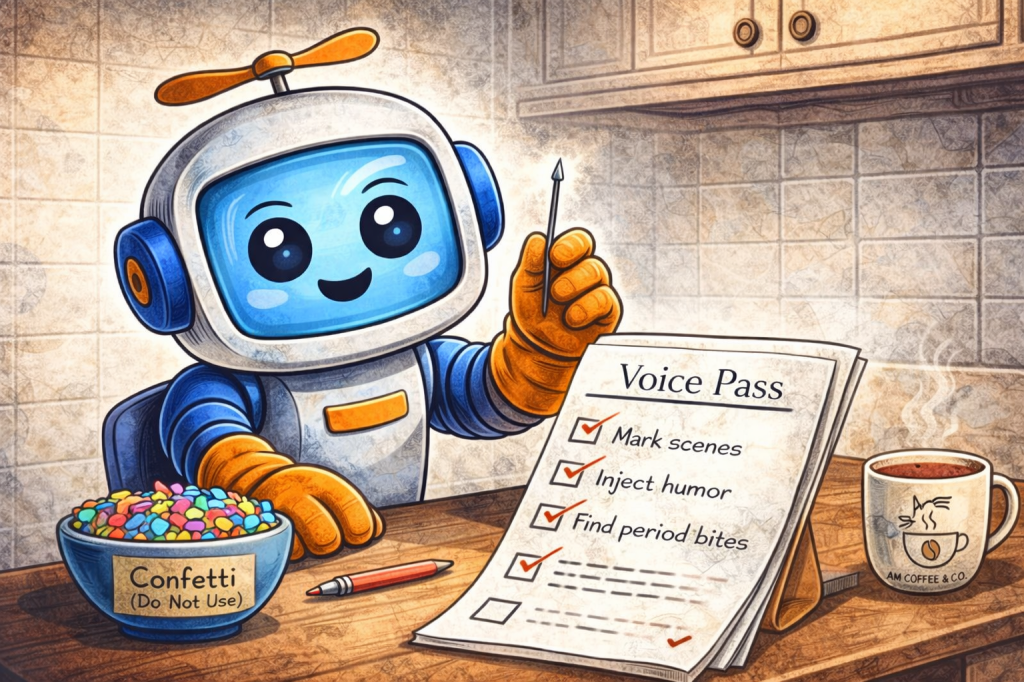
Here’s the Voice Salvage Pass—simple enough that I can pull it off without spiraling into Revision Olympics.
- Mark the scenes that used to crackle and now feel flat.
- Re-inject humor strategically—one or two sharp lines per scene, not a confetti cannon.
- Swap modern snark for period-true bite (same attitude, older phrasing).
- Look for “polished-but-bland” sentences and trade them for my natural cadence.
- End with one clean consistency sweep so the voice feels intentional, not pasted on.
Scripty described it perfectly: not everywhere, not constantly—more like… a hatpin.
Take-away
If you’re using AI (or any revision system), let it help you get the structure solid and the prose clean—but don’t outsource your voice. When a draft starts reading “better” but feeling flatter, you don’t need to start over. You need a voice pass: keep the upgrades, then put the spark back in on purpose.
Polished is good. Polished-and-dead is not.
Don’t miss any updates on my writing exploits! Subscribe to my newsletter.


 deborahsholman.com
Leave a comment