A love letter to every writer who’s ever found a typo … after launch.
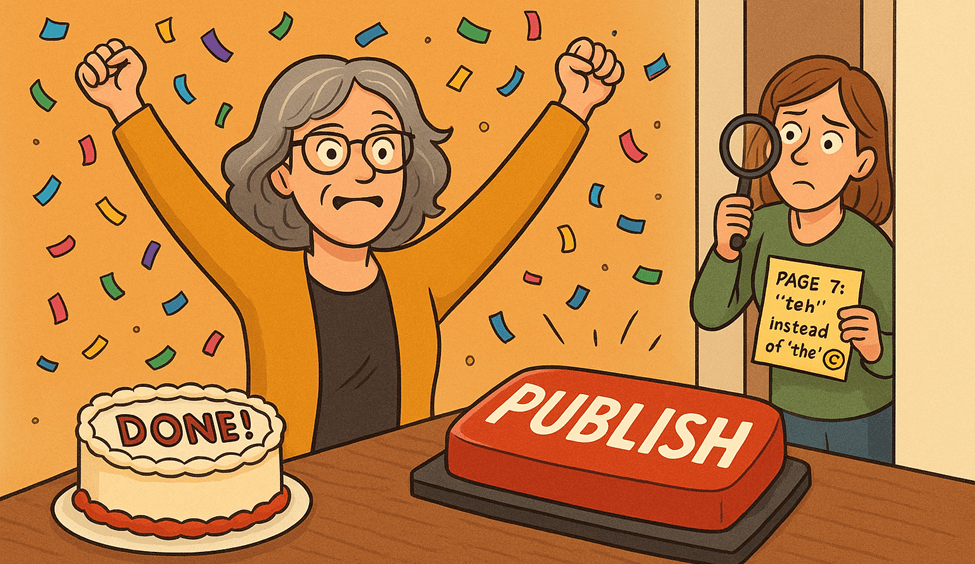
I thought I was done.
I revised the children’s book. I corrected all the errors. I double-checked the margins, the text boxes, the captions. I pressed the magic button: Download.
I uploaded the newest version (Number 6,262?) to Amazon. Ran it through the quality check. No problems. PUBLISH!!
But then… (after I ordered 30 copies, of course!) my sister found more errors. Teeny-weeney things. Tiny edits. The kind that feel too small to matter and yet somehow big enough to unravel your will to publish anything ever again.
I “know” it’s not a big deal. Deep breath. I reminded myself that even the Big Five publishers let things slip through. I’ve seen typos in Pulitzer Prize-winning books. I’m human. But still…
I felt deflated. Defeated. Like all the air had been let out of the moment I was supposed to feel proud. Instead of celebrating, I was spiraling—wondering if those tiny errors were proof I hadn’t done enough, hadn’t checked enough, hadn’t been enough.
So, as I seem to be doing more and frequently, I turned to Scripty McPromptface (my very professional nickname for ChatGPT 4o—don’t judge me) and requested a little therapy.

Here’s the truth I had to remind myself (and maybe you need to hear it too):
You are not broken. You are just in the refinement spiral.
It’s that maddening stage where the changes get smaller but more irritating, where your brain whispers, “If I missed that… what else did I miss?”
That whisper? It doesn’t know anything.
You are not putting trash into the world.
You are not a fraud who should give up.
You are not alone in this.
You are a writer who cares deeply about your work. And that’s exactly why this feels so hard.
So what do we do when the funk hits?
1. Take a fake deadline detox.
Pretend—just for 24 hours—that nothing is due. Not the book. Not the reprint. Not the social media or the next draft or the workshop handout. Just be someone who already wrote something beautiful. Let yourself feel that.
2. Tackle the changes with one eyebrow raised.
Put on your playlist. Light a candle. Be a little irreverent. Say “Okay, typo #37, let’s tango.” These edits don’t get to boss you around. You’re in charge.
3. Let someone else help.
If you’ve got a sibling spotting edits, or a writing assistant you call Scripty McPromptface (ahem), let them help you wrangle the chaos. You do not have to do this alone.
4. Remember your why.
You didn’t write this book to prove you could use a semicolon properly. You wrote it to honor your family. To create a legacy for your family. To say: We were here. We mattered.
That’s what readers will remember. Not the comma.
You’re allowed to want to quit. But don’t. Because you’ve come too far. You’ve already written “The End.” You’ve already made something meaningful. And no rogue punctuation mark can undo that.
You’ve got this. And if you need to sit in the funk a little longer, that’s okay too. Just know this:
I’m right here—with tea, tissues, and typo-extermination tools.
So here’s to pressing “Publish” anyway. Because done is a direction, not a finish line.
Thirty copies are on their way. Maybe with a typo or two. But also with heart, history, and the kind of love no red pen can erase.


Leave a Reply