Sometimes the hardest part of writing narrative nonfiction is imagining scenes that were never recorded.
Sometimes the scenes are already waiting for you in a 125-year-old newspaper.
When I wrote Nothing Really Bad Will Happen, I often had to reconstruct scenes from fragments. I knew where my ancestors lived and what they looked like, but I couldn’t know their voices, gestures, or everyday conversations. Those details had to be imagined while remaining faithful to the historical record.
Catherine was the opposite.
The newspapers often handed me scenes! Journalists in the late nineteenth and early twentieth centuries often filled their articles with dialogue, descriptions, and colorful courtroom details. (I was shocked at some of the descriptions written about Catherine. Today’s journalists would probably be sued!)
Take a look at this article:
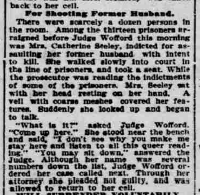
In the passage below, several phrases (in bold) come directly from the original newspaper account. Everything between them is my attempt to connect those documented moments into a coherent narrative.
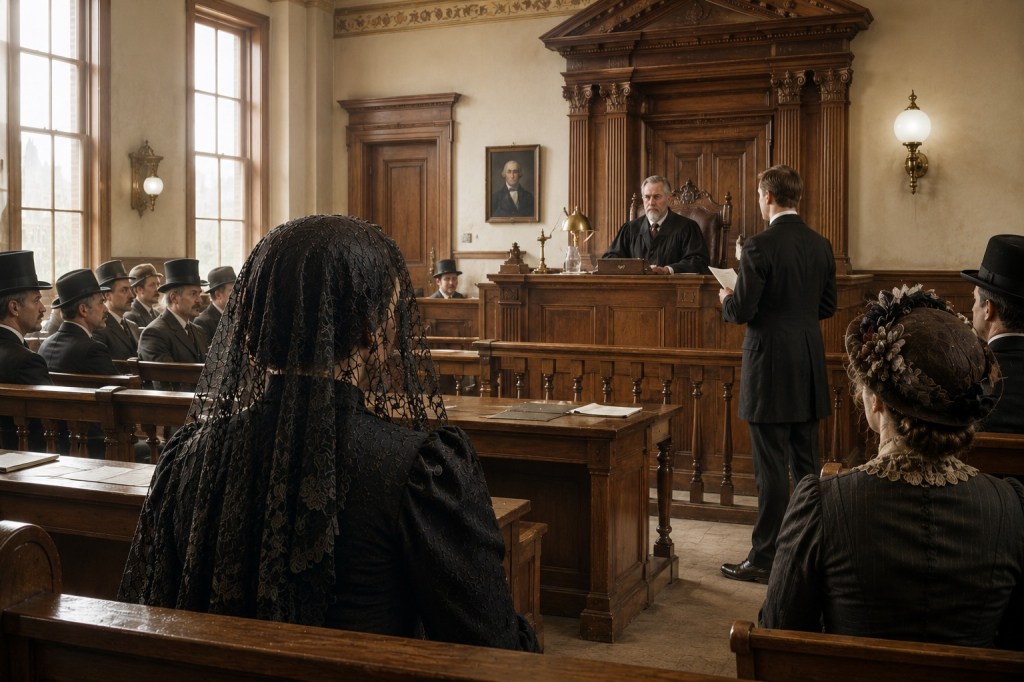
The next morning, Catherine took her place in the line of thirteen prisoners shuffling into Judge Wofford’s courtroom. She settled herself on the bench, peering through her heavy black veil. The gallery was thin, only a scattering of faces. As the prosecutor droned through the list of indictments, her head sagged forward. Her eyes fluttered.
“Seeley. Assault with intent to kill.”
Her name cut through the fog. She jerked upright, heart hammering.
“Kill?” The word squeaked from her throat. She swallowed and tried again. “I didn’t set out to kill.”
Judge Wofford leaned forward. “What are you saying, Mrs. Seeley? Step up here.”
Her shoulders sagged, then squared as she said, “I don’t see why you make me stay here and listen to all this queer reading.”
Without meeting her gaze, he gave a short, impatient nod. “You may sit down.”
Catherine lowered herself onto the hard wooden bench, eyes downcast. Her case was listed second-to-last—she had checked the docket herself. Yet Judge Wofford glanced at the page and called her name almost at once. Murmurs rippled through the gallery. The meaning was clear enough: Wofford wanted her case gone, the sooner the better. Her attorney stood, clearing his throat. “Your Honor, my client pleads not guilty.”
Judge Wofford gave a slight nod. “So noted. She may return to her cell.”
The gavel struck. Catherine exhaled and rose, saying nothing. The bailiff moved toward her, but she had already turned. Her black skirts whispered against the floor as she walked, back straight, chin high, giving no one the satisfaction of a reaction.
She wasn’t broken yet.
My job as the author wasn’t to invent the scene. The reporter for the St. Louis Republic had already done that. Mine was to verify the reporting, place it in context, and weave it into a narrative that remained faithful to the historical record.
Sometimes the most remarkable stories aren’t created by the author—they’ve been waiting in the archives all along.
Behind the Chapter is an occasional series exploring the original documents, photographs, maps, and newspaper accounts that helped bring Countess of Cons to life. I hope you’ll enjoy seeing how these fragments of history became a story.


Leave a Reply