At some point, you have to stop researching and write the book.
At least, that is what I keep telling myself.

I began researching Catherine Seeley more than ten years ago, and much of my original research was done between 2015 and 2017. I wish I could say that from the very beginning I carefully labeled every newspaper clipping, recorded every publication date and page number, and maintained impeccable source files.
I did not.
I saved things because they were interesting. I took screenshots. I downloaded newspaper clippings. Sometimes I recorded exactly where they came from. Sometimes, apparently, I assumed I would remember.
My 2016 self had far more confidence in my memory than she had any right to.
Over the years, my research habits became much more disciplined. They had to. Catherine’s story grew from an interesting piece of family history into Countess of Cons, a book built from hundreds of newspaper articles, court records, city directories, census records, vital records, and other primary sources.
The manuscript has been revised, read, revised again, proofread, and published.
The research, I thought, was finished too.
Then I went looking for one newspaper article.
The Article I Couldn’t Find
I wanted to write an author-blog post about a particularly strange episode from Catherine’s life in the summer of 1897, when she arrived in Brunswick, Missouri, with two babies she intended to place with local families.
Years ago, I had found a newspaper story with the wonderfully alarming headline:
FARMS OUT HER BABIES.
Chief Hayes Will Investigate Mrs. J. C. Seeley’s Business.
I knew the article existed. I had used information from it in the book.
There was just one problem.
I couldn’t find the article.
I searched my computer. I searched my files. I searched newspaper databases using the headline, pieces of the headline, Catherine’s name, Brunswick, babies, Chief Hayes, and various combinations of all of the above.
Nothing.
And knowing that somewhere, sometime, I saw a newspaper article is not exactly the standard of documentation I try to maintain these days.
So I kept searching.
I still haven’t found it.
Instead, I found three articles I had never seen before.
A Story I Thought I Already Knew
The first appeared in The Brunswicker on July 31, 1897.
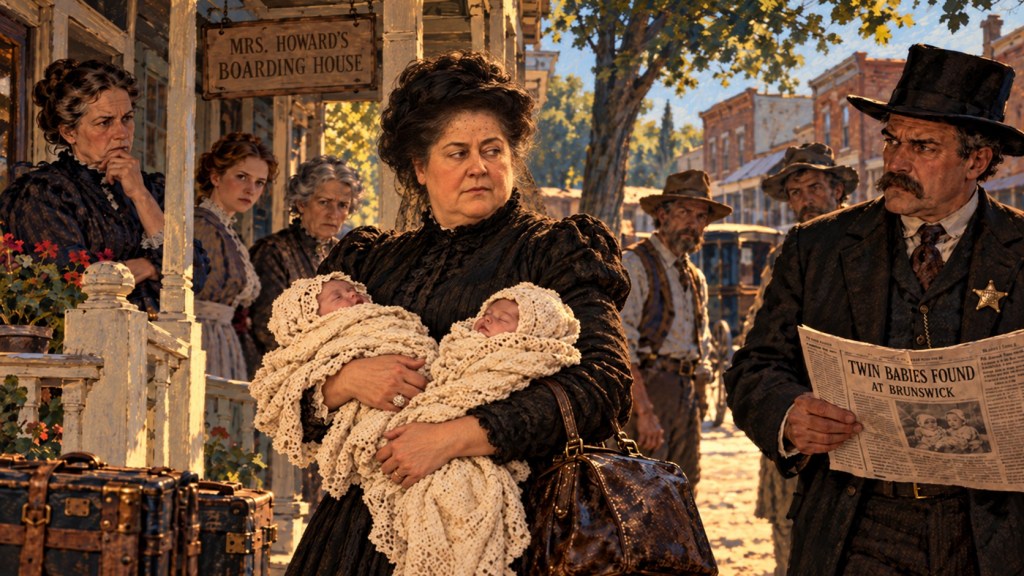
It reported that a woman calling herself Mrs. C. J. Seeley had arrived from Kansas City with two babies. She claimed to represent a maternity home at 2141 East Eighth Street and said she had been entrusted with finding good homes for the children.
Except her story apparently changed depending upon whom she was talking to.
According to the newspaper, Catherine told some people that the Kansas City police had given the babies to her. She told others that they had come from the maternity home.
Then she placed one of the babies in a home that local officials considered unsuitable. Mayor Perkinson intervened and ordered her to remove the child. Eventually, Catherine found other homes for both babies.
As I read the article, I had the peculiar sensation of reading a newspaper account of something I had already written.
This is how the episode appears in Countess of Cons:
Two swaddled infants lay bundled in her arms—the same two she claimed to have rescued from a bleak maternity hospital. The story had held so far. One child had nearly been placed until Mayor Perkinson, in a fit of righteous meddling, declared the home unsuitable. What did he know? His interference had left her saddled with both infants again, forced to begin the search anew.
This time she had been more careful.
The newly discovered article didn’t contradict the scene.
If anything, it strengthened it.
But then I kept reading.
Apparently, Catherine was not pleased that the newspaper intended to report what she had been doing.
According to the editor, she warned that if he published the story, an “unexpected death” would overtake him.
I have spent more than ten years researching this woman.
Somehow, I had missed the part where she apparently threatened a newspaper editor.
And Then There Were Two More
A second item in the same July 31 issue was much shorter, but it gave me something the longer article hadn’t.
It said Catherine had come to Brunswick “to see about arranging homes” for three young Morgan children who had recently been sent to the county home.
That stopped me.
Until now, I knew what Catherine did in Brunswick. I knew she solicited contributions and tried to place children in homes.
But this tiny article may help explain why Brunswick was on her itinerary in the first place.
Then I found a third article, published the following week.
By August 7, Catherine had moved on to Jonesburg, Missouri, where she was reportedly collecting money to support her work. David Gay, superintendent of the Interdenominational Orphans’ Home in St. Louis, had heard about what happened in Brunswick and confronted her.
Catherine denied the accusations.
She denied placing a child in an unsuitable home. She denied representing an organization. And she denied threatening the newspaper editor.
The Brunswicker stood firmly behind its original account.
More than a century later, I found myself sitting at my computer trying to determine which parts of Catherine’s story I could prove.
Apparently, not much has changed.
So Do I Change the Book?
That was the inevitable question.
Actually, my first thought was probably something closer to:
You’ve got to be kidding me.
The book is published. Just because I can change it, doesn’t mean I should.
But when you write about a real person, new evidence does not politely stop appearing just because you’ve typed THE END.
So I asked myself a question:
Does this new information change the story, or does it simply add to the story?
Most of what I found adds to it.
The new articles confirm things I already knew: Catherine brought babies to Brunswick, attempted to place them with local families, encountered opposition from Mayor Perkinson, solicited money, and attracted suspicion.
The contradictory stories about where the babies came from add another layer. The alleged threat against the editor is fascinating—and, after everything I’ve learned about Catherine, perhaps not entirely surprising.
But neither fundamentally changes the story I have already told.
The Morgan children may be different.
That little article may help explain what brought Catherine to Brunswick. That may deserve a sentence in the book. Someday. When I decide to correct the typos that mysteriously appeared during the printing process. (Because, obviously, I didn’t miss them during the 1,245 proofreading passes!)
One sentence.
I am writing that down largely to remind myself.
Because this is how historical research gets you.
One new sentence requires checking one new fact. One fact leads to another newspaper search. That search produces another name. The name leads to another record.
And suddenly it is three o’clock in the morning and you’re trying to determine what happened to three children who entered a Missouri county home in 1897.
Maybe Historical Research Is Never Finished
When I began researching Catherine, I thought there would eventually come a point when I had finished her story.
Ten years later, I’m not sure that point exists.
There will always be another newspaper that hasn’t been digitized. Another article whose optical character recognition is so mangled that no reasonable search will find it. Another courthouse record sitting in a box. Another tiny paragraph buried three columns away from the story you were actually looking for.
Sometimes a new discovery changes what you thought you knew.
Sometimes it confirms it.
Sometimes it fills a tiny hole you hadn’t realized was there.
And sometimes it tells you that your husband’s great-great-grandmother may have threatened to kill a newspaper editor.
Perhaps finishing historical research doesn’t mean you’ve found everything.
Perhaps it means you’ve found enough to tell the story responsibly—and you’ve learned to recognize when something new requires you to change that story and when it doesn’t.
As for the newspaper article that started this entire search?
I still haven’t found it.
Instead, I found three other pieces of Catherine’s story I didn’t know were missing.
Apparently, no one has told Catherine that I finished the book.
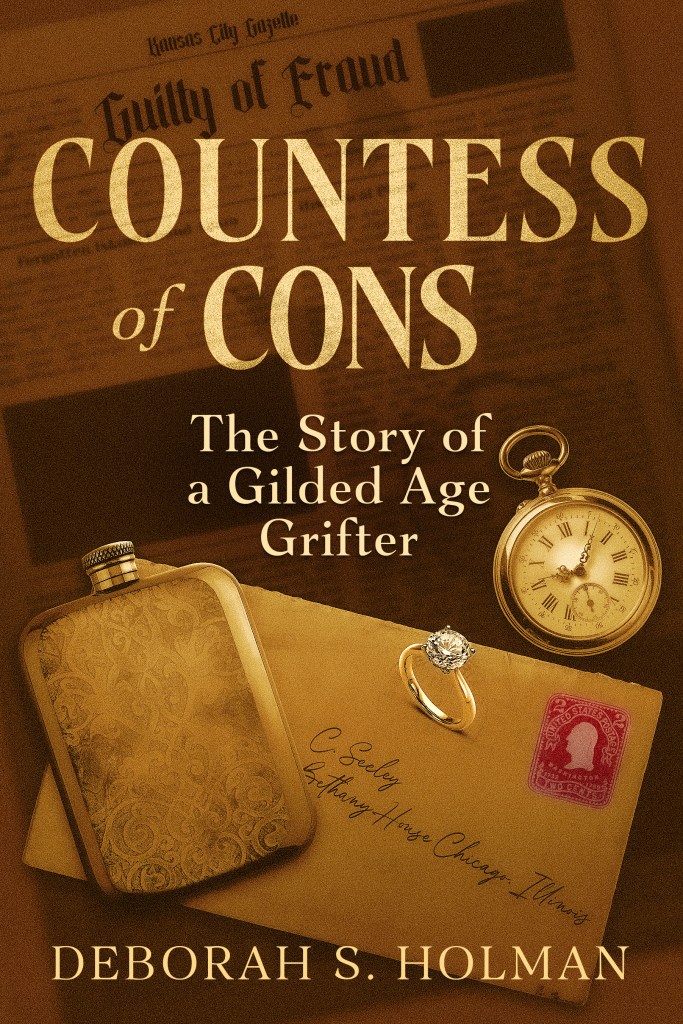
Want to know more about Catherine Seeley’s extraordinary life? Her adventures, reinventions, and remarkable schemes are chronicled in Countess of Cons: The True Story of a Gilded Age Grifter.


Leave a Reply