Explore the Research:
JUMP TO: Research Timeline · Catherine’s Origins · Catherine & William · Newspapers · Court & Legal Records · Catherine’s Daughters · Extended Family · How I Tracked Catherine · Names & Conflicting Evidence · Research Collections · Genealogy Blog · About This Research Archive · The Story in the Records
Following Catherine’s Paper Trail
Countess of Cons: The Story of a Gilded Age Grifter grew out of genealogical research that began with a family story.
For generations, Catherine Josephine Kenney Seeley was remembered in my husband’s family as a sweet, gentle grandmother. Then I found a newspaper clipping.
That clipping led to another. And another.
Over years of research, Catherine emerged from census records, newspapers, court proceedings, city directories, vital records, probate files, church records, property records, and other historical sources. The woman documented in those records was considerably more complicated than the woman preserved in family memory.
The book is written as narrative nonfiction. The events, dates, places, relationships, court proceedings, and other historical facts are grounded in the documentary record. Where the historical record could not tell me what Catherine or another person thought, felt, or said privately, I used informed reconstruction to bring the story to life rather than presenting imagined material as documented fact.
This page is not intended to be a formal bibliography or a citation for every fact in the book. Instead, it preserves some of the principal records behind the story for readers, family members, genealogists, and future researchers who would like to follow Catherine’s paper trail for themselves.
The research described here began many years before publication and continued throughout the writing of the book. The sources below represent selected foundational records rather than the complete research archive.
From One Clipping to Countess of Cons: A Research Timeline
Catherine’s story did not emerge all at once. It developed over years as one record led to another, old assumptions were challenged, and new discoveries changed my understanding of her life.
The Family Story
My starting point was Our Archipelago, a family history written in 1976 by Catherine’s grandson, William W. Holman. His Catherine was small, gentle, and beloved by her children and grandchildren. The family knew her as Catherine FitzAllen.
There seemed little reason to question that story.
The Clipping That Changed Everything
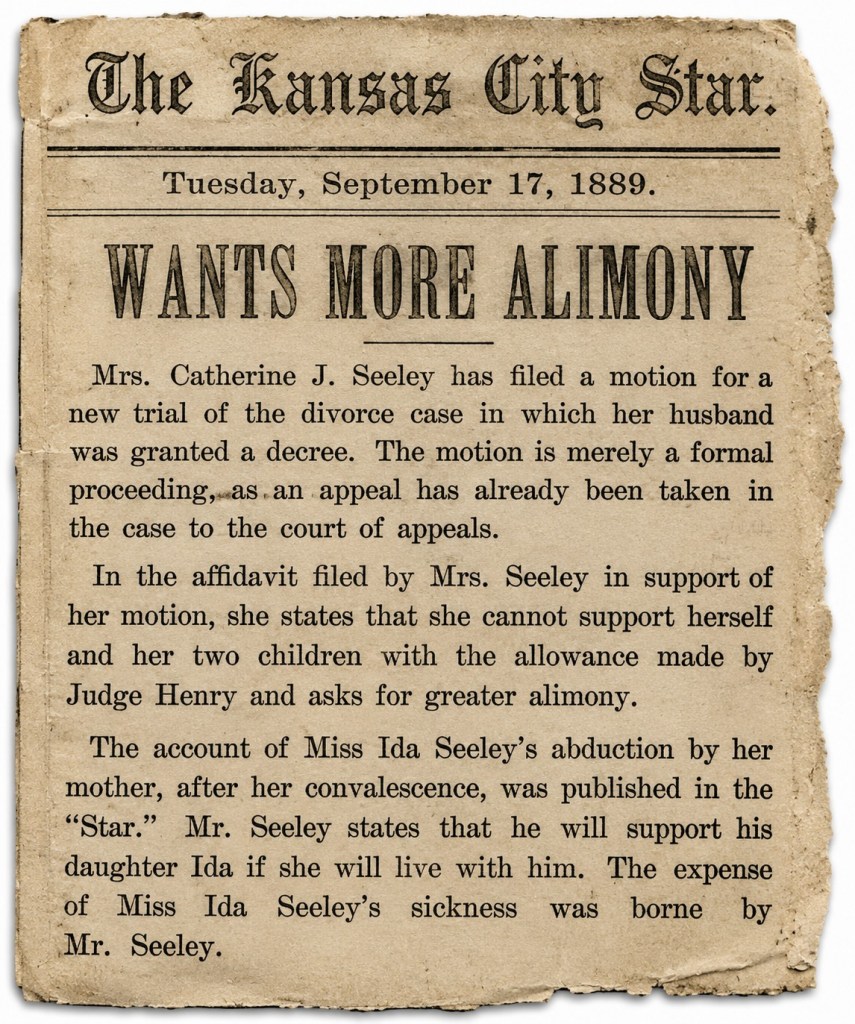
Years later, I encountered an 1889 Kansas City newspaper article concerning a woman named Catherine J. Seeley and a sensational divorce involving her husband, William Seeley, and their daughter Ida.
The surname was different, but too many details matched the family I knew.
I started digging.
2017–2018: Following the Paper Trail
By 2017, the research had grown into a substantial genealogical database containing census records, vital records, newspapers, city directories, court documents, probate files, church and cemetery records, property records, and family material.
Newspaper searches revealed Catherine in city after city and under name after name. Court and legal records began providing evidence beyond what reporters had written about her.
I created timelines, spreadsheets, research plans, and an alias map simply to keep track of her.
In 2018, that research became Opulent in Aliases: Who Was Catherine C. FitzAllen? It was my first attempt to assemble Catherine’s complicated history into a book.
But Catherine’s paper trail wasn’t finished with me.
2018–2024: The Research Continues
Publication of Opulent in Aliases did not end the investigation. New records and newspaper accounts continued to surface, some filling gaps and others raising entirely new questions.
One of the most revealing discoveries involved Catherine’s daughter Ida. In the 2018 book, I knew that Ida had homesteaded in Oklahoma, married Baptist minister Richard Hill in 1907, and later returned to Chicago. Later research uncovered a very different story. Ida appears to have created an organization called the Children’s Home Finding Association of the State of Oklahoma, using versions of family names for its supposed board of officers. Her husband’s name appeared among the officers, lending the enterprise clerical respectability, while other names appear to have been drawn from members of her own family.
The discovery changed the way I understood Ida. Rather than simply being caught up in someone else’s questionable charity, she appears to have constructed one herself. The parallels with Catherine’s long history of soliciting money in the name of orphan and children’s homes were striking and suggested just how deeply mother and daughter may have remained intertwined. I came to suspect that Catherine had encouraged or inspired the plan, although the surviving records do not prove that directly. The episode also offered a possible explanation for Ida’s sudden return to Chicago after the organization attracted unfavorable newspaper attention.
Other newly found newspaper accounts continued to expand Catherine’s trail, adding episodes, aliases, and details that had not been part of my original research.
The Catherine I understood in 2018 was not yet the complete Catherine I would eventually uncover.
2024–2026: From Genealogical Study to Narrative Nonfiction
In 2024, I began rethinking how Catherine’s story should be told. Rather than simply revising the earlier book, I returned to the accumulated evidence and rebuilt the story as narrative nonfiction.
Research continued alongside the writing. In November 2024, I located an 1889 Kansas City Journal article concerning a forgery accusation, adding another contemporary account to Catherine’s early Kansas City years. Other discoveries extended the documentary trail into the twentieth century, including a 1906 Mapleton Dispatch article describing “Mrs. C. J. Seeley” soliciting money for the supposed Goodlander Home.
By then, the research was doing more than adding facts. It was changing relationships, motives, and chronology—showing me connections I had not recognized in 2018 and giving greater context to events I had previously been able only to describe.
After years of research, writing, restructuring, fact-checking, and revision, Countess of Cons: The Story of a Gilded Age Grifter was published in September 2026.
The book was finished.
The research probably never will be.
Catherine Kenney Seeley: Origins and Family
One of the first challenges was establishing Catherine’s identity before she became Catherine Seeley—and before the aliases and reinventions that complicated her later life.
Among the records used to reconstruct Catherine’s early family were:
- New York State Census, 1855 — documents members of the Kenney family in Albany, New York.
- New York State Census, 1865 — provides additional evidence concerning the Kenney family in Albany.
- New York State Census, 1875 — documents Catherine and William Seeley’s household in Albany.
- 1860, 1870, and 1880 United States censuses — used to trace Catherine, William, their family, residences, and occupations.
- Irish Catholic parish registers — include baptismal records associated with Catherine and members of the Kenney family.
- St. Joseph Church records, Albany — contain baptismal and other records associated with members of the Kenney family.
- Albany city directories and property records — helped establish residences, occupations, and movements of Catherine, William, and their relatives.
Together, these records helped distinguish Catherine’s documented origins from identities she would later claim.
From the Original Records
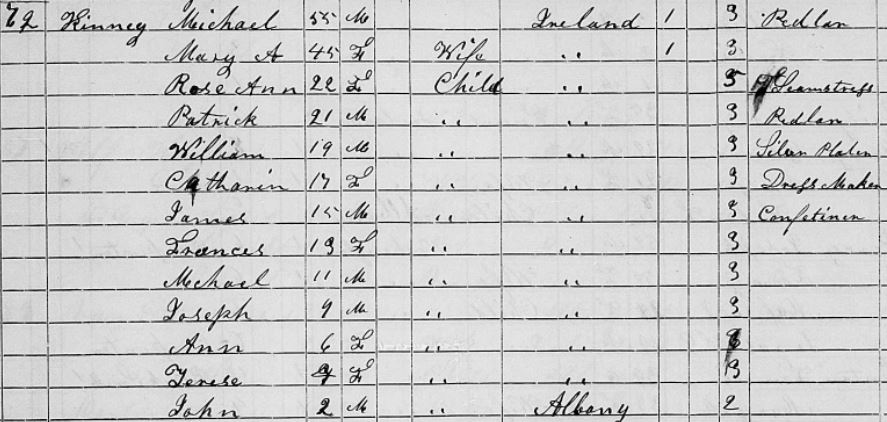
Michael and Mary Kenney household, including their daughter Catherine, age 17. The family was indexed under the surname Kinney.
Source: New York State Census, 1855; digital image accessed via Ancestry.com.
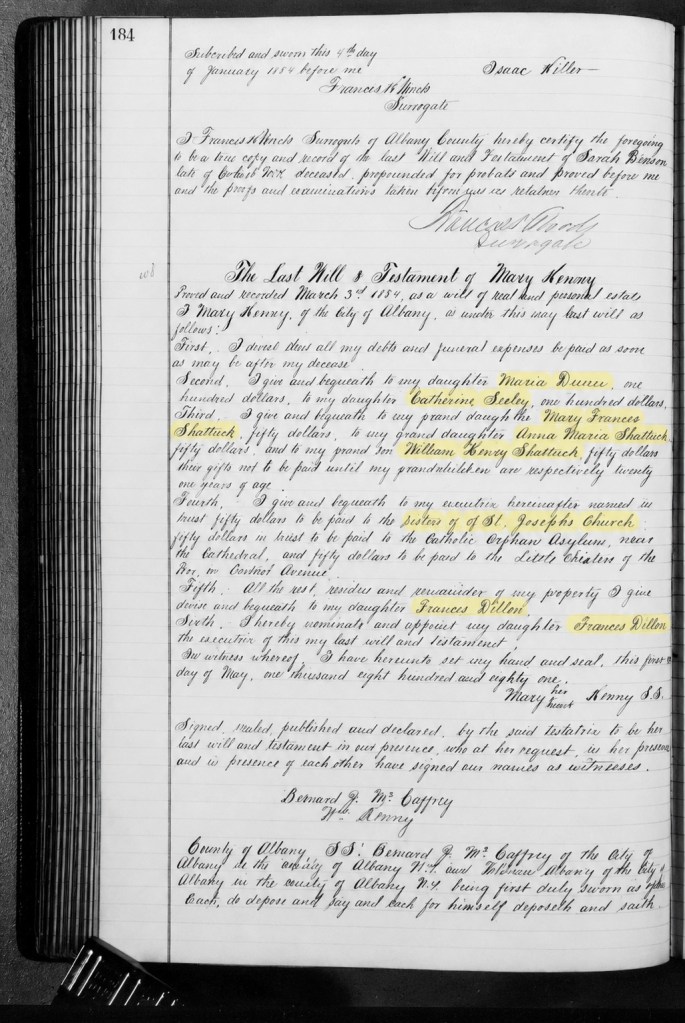
New York, Wills and Probate Records, 1659–1999, Albany County (New York), Surrogate’s Office, Wills, Letters Testamentary, Letters of Administration, etc., 1787–1902, p. 184, will of Mary Kenney; Ancestry.com Operations, Inc., Provo, Utah, 2015.
Catherine and William Seeley
Census records, city directories, newspapers, property records, and court documents were used to reconstruct the Seeley marriage and the family’s movements.
Particularly important records include:
- 1875 New York State Census, Albany — places William and Catherine Seeley together in Albany.
- 1880 United States Census, Albany — documents William’s occupation and the Seeley household.
- Albany city directories — trace William’s occupations and residences.
- Albany newspapers — contain business and legal notices involving William Seeley.
- Kansas City city directories — document William’s later occupations and residences in Missouri.
- Jackson County Circuit Court divorce record, 1889 — surviving court documentation of William and Catherine’s divorce.
- Kansas City newspaper coverage, June 1889 — reports that William Seeley was granted a divorce.
The divorce record and contemporary newspaper reporting were especially important because they provide evidence created at the time the marriage was actually ending rather than later family recollection.
Newspapers: Catherine in Public
Newspapers became one of the richest sources for reconstructing Catherine’s life.
Contemporary reporting allowed me to follow not merely where Catherine lived, but how she presented herself, how others described her, and how her activities came to the attention of courts, police, institutions, creditors, and the public.
Research for the book drew upon newspapers from the communities through which Catherine and her family moved, including Kansas City, Chicago, Albany, Denver, Leavenworth, Lawrence, Topeka, St. Louis, and numerous other communities connected to Catherine’s travels, schemes, legal troubles, and family.
The newspaper research eventually extended across dozens of individual publications.
Newspapers Consulted
Click Arrow at left to expand
Albany Evening Journal — Albany, New York
Albany Morning Express — Albany, New York
Albany Times Union — Albany, New York
Alton Evening Telegraph — Alton, Illinois
Bloomington Daily Leader — Bloomington, Illinois
Boston Herald — Boston, Massachusetts
Brookfield Gazette — Brookfield, Missouri
Carroll Sentinel — Carroll, Iowa
Centralia Sentinel — Centralia, Illinois
Chicago Chronicle — Chicago, Illinois
Chicago Daily News — Chicago, Illinois
Chicago Herald — Chicago, Illinois
Chicago Record — Chicago, Illinois
Chicago Tribune — Chicago, Illinois
Columbus Daily Times — Columbus, Indiana
Crawford Avalanche — Grayling, Michigan
Daily Albany Argus — Albany, New York
Daily Illinois State Journal — Springfield, Illinois
Daily Illinois State Register — Springfield, Illinois
Daily Intelligencer — Wheeling, West Virginia
Daily Inter Ocean — Chicago, Illinois
Daily Record
Daily Times (Davenport, Iowa) — Davenport, Iowa
Daily Times (Troy, New York) — Troy, New York
Davenport Weekly Republican — Davenport, Iowa
Duluth News-Tribune — Minnesota
Elkhart Weekly Review — Elkhart, Indiana
Ellsworth Reporter — Ellsworth, Kansas
Evening Star (Independence, Kansas) — Independence, Kansas
Independence Daily Reporter — Independence, Kansas
Indianapolis Journal — Indianapolis, Indiana
Indianapolis News — Indianapolis, Indiana
Iola Register — Iola, Kansas
Journal and Courier
Kalamazoo Gazette — Kalamazoo, Michigan
Kansas City Gazette — Kansas City, Missouri
Kansas City Journal — Kansas City, Missouri
Kansas City Star — Kansas City, Missouri
Kansas City Times — Kansas City, Missouri
Kiowa Herald — Kiowa, Kansas
Knickerbocker News — Albany, New York
Lawrence Daily Gazette — Lawrence, Kansas
Lawrence Daily Journal — Lawrence, Kansas
Lawrence Daily World — Lawrence, Kansas
Le Mars Globe — Le Mars, Iowa
Leavenworth Times — Leavenworth, Kansas
Leavenworth Weekly Times — Leavenworth, Kansas
Logansport Pharos-Tribune — Logansport, Indiana
Los Angeles Times — Los Angeles, California
Lucas Sentinel
Luray Herald
Medicine Lodge Cresset — Medicine Lodge, Kansas
Morning Star (Rockford, Illinois) — Rockford, Illinois
Muskegon Chronicle — Muskegon, Michigan
New York Herald — New York, New York
New York Press — New York, New York
New York Sun — New York, New York
New York Tribune — New York, New York
Omaha Daily Bee — Omaha, Nebraska
Omaha World-Herald — Omaha, Nebraska
Ottumwa Tri-Weekly Courier — Ottumwa, Iowa
Salina Evening Journal — Salina, Kansas
Sedalia Weekly Democrat — Sedalia, Missouri
Sheridan Advance
South Bend Tribune — South Bend, Indiana
St. Joseph Gazette-Herald — St. Joseph, Missouri
St. Joseph Herald
St. Joseph Weekly Gazette — St. Joseph, Missouri
St. Louis Globe-Democrat — St. Louis, Missouri
St. Louis Post-Dispatch — St. Louis, Missouri
St. Louis Republic — St. Louis, Missouri
St. Paul Daily Globe — St. Paul, Minnesota
Topeka Daily Capital — Topeka, Kansas
Topeka State Journal — Topeka, Kansas
Topeka Weekly Capital — Topeka, Kansas
Weekly Record (Lawrence, Kansas) — Lawrence, Kansas
Weekly Star and Kansan — Independence, Kansas
Westphalia Times — Westphalia, Kansas
Wheeling Daily Intelligencer
Wichita Daily Eagle — Wichita, Kansas
Wilson World — Wilson, Kansas
Winfield Tribune — Winfield, Kansas
Mapleton Dispatch — Mapleton, Kansas
Wilson County Sun — Wilson County, Kansas
These newspaper accounts were compared with genealogical and legal records whenever possible. Newspaper reporting can contain errors, exaggeration, contradictory details, and colorful language, so an article was not automatically treated as fact simply because it appeared in print.
That tension—between what Catherine said, what newspapers reported, what her family remembered, and what surviving records could establish—became central to reconstructing her story.
A Glimpse of the Newspaper Trail
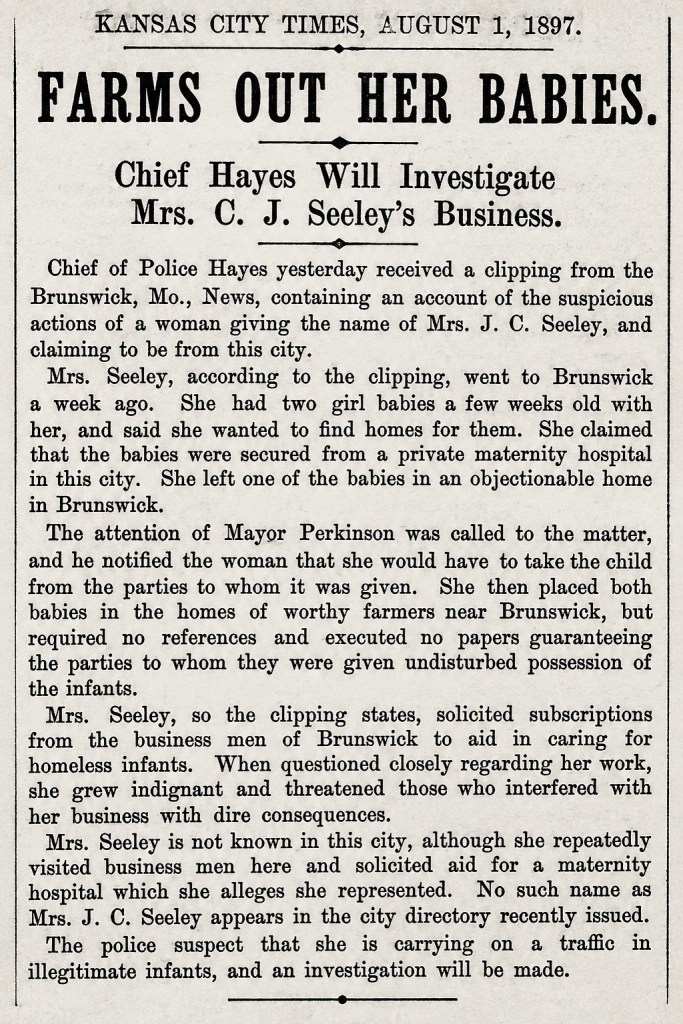
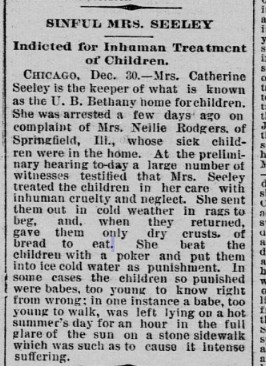
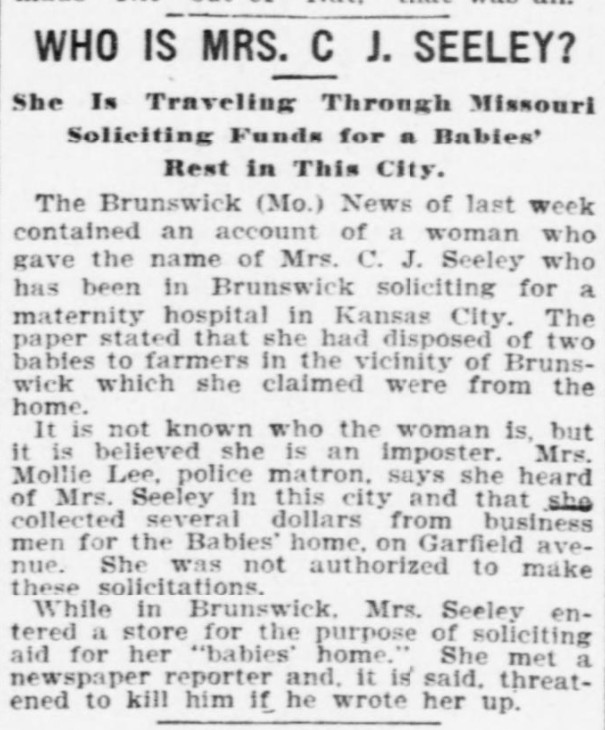
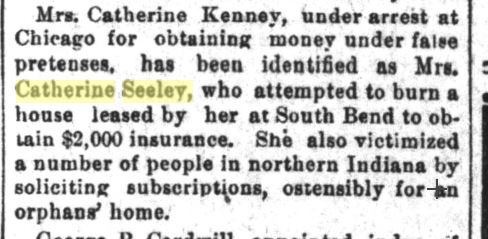
Sources: 1) “Farms Out Her Babies,” Kansas City Times, August 1, 1897, p. 6, Newspapers.com. 2) Indianapolis News (Indianapolis, Indiana), January 18, 1892, p. 6, Newspapers.com. 3) “Who Is Mrs. C. J. Seeley?,” Kansas City Journal (Kansas City, Missouri), August 1, 1897, Library of Congress. 4) “Sinful Mrs. Seeley,” St. Paul Daily Globe (Saint Paul, Minnesota), December 31, 1890, Library of Congress.
Court, Legal, Property, and Probate Records
Legal records provided some of the strongest evidence behind Countess of Cons. They were particularly valuable when Catherine’s own claims—or newspaper accounts about her—conflicted with other evidence.
Among the records consulted were:
- Jackson County Circuit Court records concerning William and Catherine Seeley’s 1889 divorce.
- Records connected with Catherine’s 1890 arrest and conviction in Lawrence, Kansas.
- 1892 indictment papers involving Catherine Seeley. Copies of surviving indictments were obtained during the earlier phase of my research.
- Marriage records documenting later marriages involving Catherine and members of the Seeley family.
- 1899 divorce papers involving Katherine “Kitty” Seeley Graham.
- 1900 Graham divorce decree.
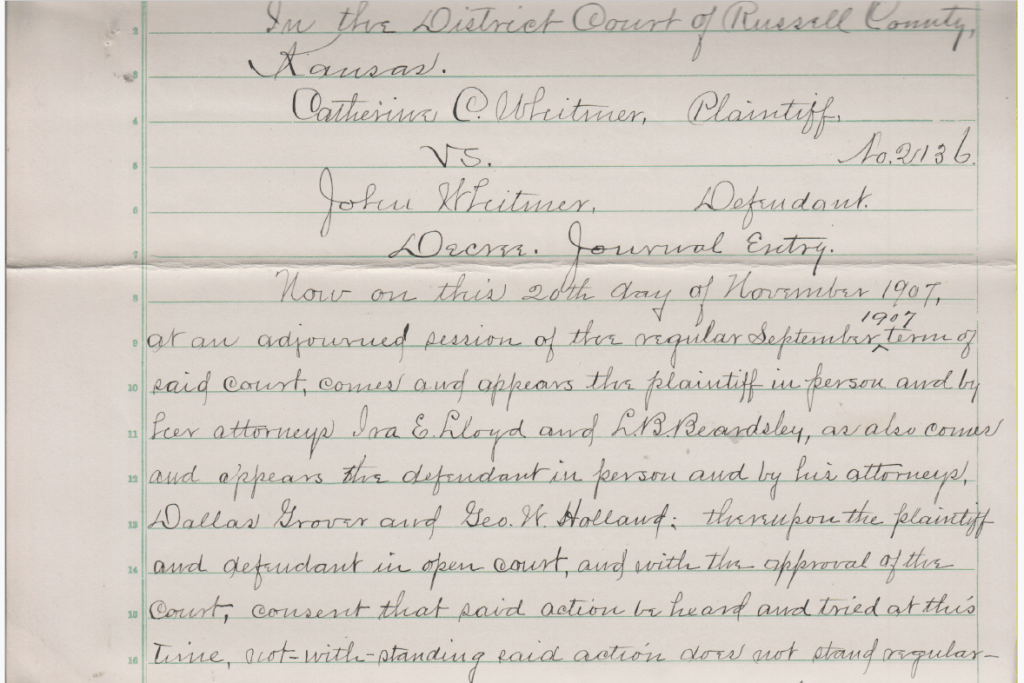
- 1907–1908 Whitmer v. Whitmer divorce records from Russell County District Court.
- Property and deed records used to establish ownership, residence, and financial relationships.
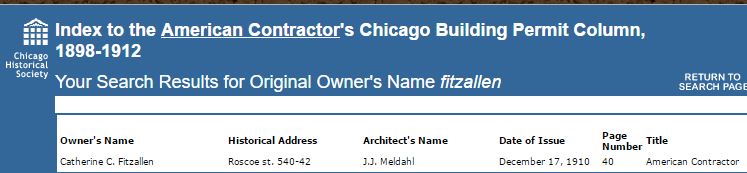
- 1910 property-transfer records associated with the Roscoe Street property in Chicago.
- 1914 property-transfer records associated with the Glenview property.
- Wills and probate records involving Catherine and members of the extended family.
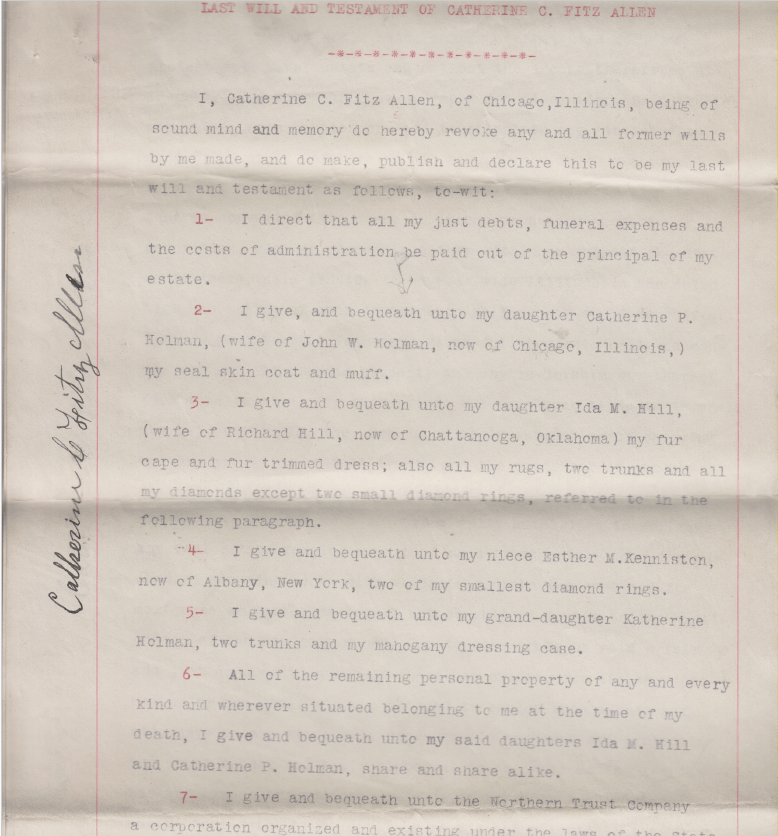
- Catherine’s will and probate papers.
- Catherine’s Illinois death record, recorded under the name Catherine C. Fitzallen.
These documents sometimes confirm newspaper accounts. At other times, they complicate them. Together they provide an important counterweight to Catherine’s own changing versions of events.
From the Case Files
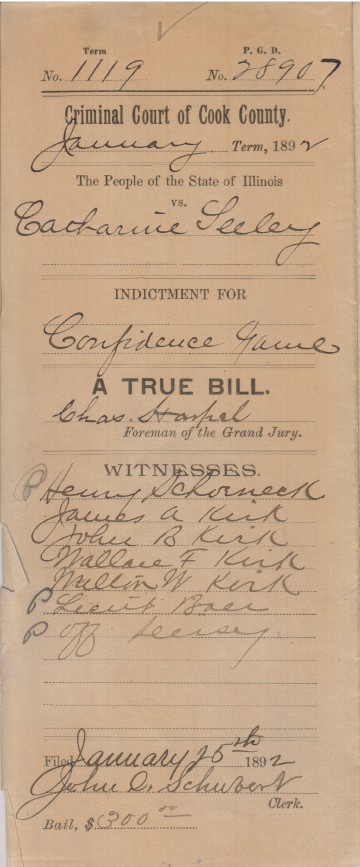
Following Catherine’s Daughters
The documentary trail also made it possible to follow Catherine’s daughters, Ida and Katherine “Kitty” Seeley, independently of their mother.
Sources include:
- Census records
- Marriage records
- City directories
- Newspaper society columns
- Travel notices
- Property records
- Legal and divorce records
- Death and burial records
Newspaper coverage of Ida’s social activities in Kansas City, for example, provides a glimpse of a daughter participating in a very different public world from the one increasingly associated with her mother.
Records relating to Kitty’s marriages and later life likewise helped establish where Catherine’s daughters were—and sometimes where Catherine was not.
Following the daughters separately became an important way of testing Catherine’s chronology.
The Extended Family
Because this story began as genealogy, the research extended well beyond Catherine herself.
Records concerning the Kenney, Seeley, Holman, Hill, Root, Pihlstrom, Dillon, Shattuck, Nash, and related families were used to establish relationships and distinguish family tradition from documented history.
Sources included:
- Federal and state censuses
- Birth, baptismal, marriage, and death records
- Cemetery and burial records
- Probate files and wills
- City directories
- Church records
- Property records
- Military registration records
- Family histories and privately held family material
Some of these sources contribute only a small detail to Catherine’s story. Collectively, however, they establish the network of real people around her and make it possible to test claims against a broader documentary record.
How I Kept Track of Catherine
Researching an ordinary ancestor can be complicated.
Researching a woman who repeatedly changed her name, identity, location, story, and sometimes family circumstances required another level of organization.
During the research that led to Opulent in Aliases, I created a mind map to organize Catherine’s aliases, research questions, records, locations, and relationships. It became one of the tools I used to keep her many identities from becoming hopelessly tangled.
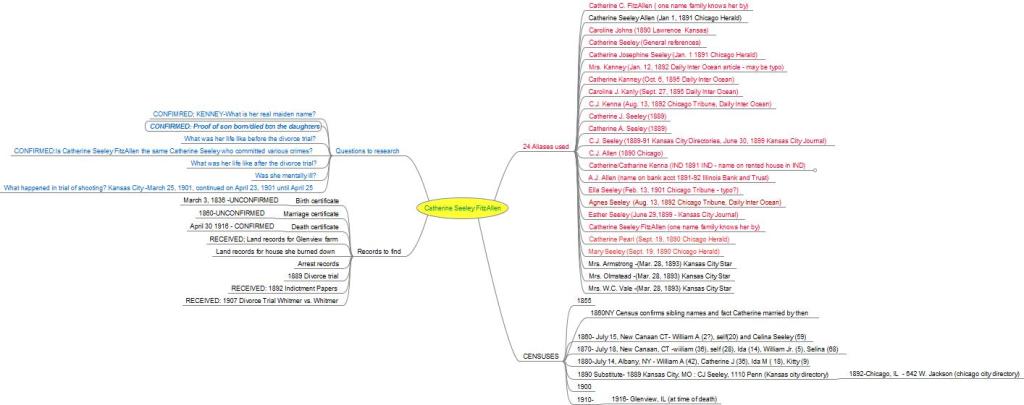
This map captures the investigation at one particular point in time. Catherine’s documentary trail continued to grow after it was created, and later research added identities, records, events, and connections that ultimately became part of Countess of Cons.
A Note About Names
Anyone researching Catherine should expect trouble.
She appears in historical records under different names and variations of names. Spelling also varies among census takers, clerks, newspapers, indexers, and databases.
Names associated with Catherine during the research therefore cannot always be treated as separate people merely because the spelling or form of the name changes.
That problem is part of Catherine’s story: some variations were ordinary nineteenth-century recordkeeping inconsistencies.
Others were not.
A Note About Conflicting Evidence
Historical records do not always agree.
Ages change. Birthplaces vary. Names are misspelled. Newspapers contradict one another. Census information depends upon whoever supplied it. Indexes can introduce errors that do not appear in the original record.
When records conflicted, I compared multiple independent sources whenever possible and gave greater weight to contemporary and original records over later recollections or derivative indexes.
Where the evidence remained uncertain, I resisted turning possibility into fact.
That distinction matters particularly in Catherine’s story because uncertainty, misdirection, and reinvention were so often part of the historical record itself.
Selected Research Collections
Much of the genealogical and historical research was conducted through or located in collections including:
- U.S. federal census records
- New York State census records
- National Archives and Records Administration collections
- New York State Archives
- Missouri state and county records
- Illinois state and Cook County records
- Jackson County, Missouri court and probate records
- Irish Catholic parish registers
- Historical city directories
- Historical newspaper archives
- Local vital and church records
- Cemetery and burial collections
- Family documents and privately held material
Digital collections and databases used during the research included Ancestry, FamilySearch, Newspapers.com, GenealogyBank, AmericanAncestors, and other archival and newspaper collections.
Whenever possible, information located through an index or database was evaluated against the underlying historical record.
More Catherine: The Genealogy Behind the Book
Long before Countess of Cons was published, Catherine appeared regularly in my genealogy research and writing.
My genealogy blog, Who We Are and How We Got This Way, includes posts about Catherine, individual discoveries, difficult research questions, aliases, family relationships, and the process of reconstructing her life from historical records.
About This Research Archive
The source material behind Countess of Cons is considerably larger than what is presented here.
My original genealogical source database was already substantial by 2017 and included census records, vital records, newspapers, directories, court documents, probate records, church records, cemetery records, property records, and family materials. Research continued after that database was created and expanded significantly during the development of Countess of Cons.
This page therefore represents a selected guide to the evidence, not a complete bibliography.
Additional documents, newspaper clippings, photographs, timelines, discoveries, and research notes may be added to this companion material over time.
For future family researchers in particular, I hope this page provides something more useful than a list of names and dates: a record of where the evidence came from, how the pieces fit together, and where questions still remain.
The Story Is in the Records
Catherine spent much of her life changing names, changing stories, and moving on.
The records did not move on with her.
A census entry here, a city directory there, a court file, a marriage record, a newspaper clipping—each preserved a small piece of a life that had nearly disappeared behind family memory.
More than a century later, those pieces made it possible to find Catherine again.
Want to meet the woman behind all these records?
Read the story behind the story

