One of my favorite parts of writing Countess of Cons was taking the fragments I found in old newspapers, court records, and city directories and figuring out how they fit together into Catherine’s story.
Sometimes a single newspaper article gave me the bones of a scene.
And sometimes another article came along and complicated everything.
That’s exactly what happened in Brunswick, Missouri, in the summer of 1897.
“Farms Out Her Babies”
On August 1, 1897, the Kansas City Times published a story with a headline that was difficult to ignore:
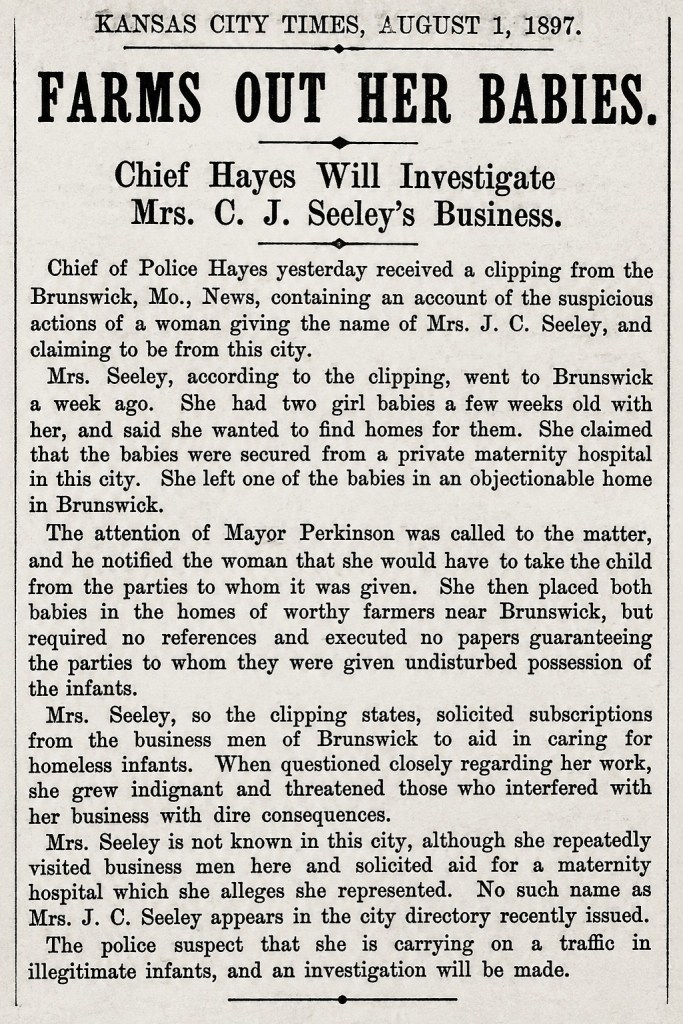
According to the article, a woman calling herself Mrs. J. C. Seeley had arrived in Brunswick with two infant girls she claimed came from a private maternity hospital in Kansas City. She was looking for homes for them.
The story became considerably more troubling from there.
One baby was initially placed in a home that local officials considered unsuitable. After the mayor intervened, both infants were placed with farmers near Brunswick. According to the newspaper, Mrs. Seeley required no references and drew up no papers guaranteeing the families possession of the children.
The article also reported that she had solicited money from Brunswick businessmen to care for homeless infants. Kansas City police, meanwhile, could find no Mrs. J. C. Seeley in the recently issued city directory and suspected that she might be involved in what the newspaper called “a traffic in illegitimate infants.”
Chief of Police Hayes planned to investigate.
There was quite a bit there for me to work with.
But there was also quite a bit I didn’t know.
I didn’t know exactly when Catherine first learned that the newspapers were onto her. I didn’t know where she was when she saw the story—or even whether she read this particular article herself.
Those are the spaces a narrative nonfiction writer has to navigate carefully.
Here is how I used the historical evidence in Countess of Cons:
From Countess of Cons
That evening, in a boardinghouse near the Brunswick depot, Catherine fanned herself with a newspaper left by a previous guest. Her eyes skimmed—until a headline snapped her upright.
FARMS OUT HER BABIES. Chief Hayes Will Investigate Mrs. J. C. Seeley’s Business.
Catherine read on, her pulse quickening. A woman calling herself Mrs. J. C. Seeley had arrived with two infant girls from a Kansas City maternity hospital and placed them with farmers without references or paperwork.
She traced a finger over the next line: No such name as Mrs. J. C. Seeley appears in the city directory recently issued. The police suspect that she is carrying on a traffic in illegitimate infants …
The insinuation was clear. They knew she was a fraud.
Catherine folded the paper and placed it in her handbag, her mind already racing. Chief Hayes in Kansas City might investigate the babies’ home she’d named—might even ask the right questions—but by the time they pieced together anything substantial, she would be long gone. Brunswick had been a misstep—nothing more. Kansas City had been the plan—until the chief had her scent. Chicago was safer now.
She’d learned that news traveled faster than trains.
And the Story Kept Traveling
That same day, the Kansas City Journal published its own account.
Its headline posed a question that could almost have served as the title of my entire research project:
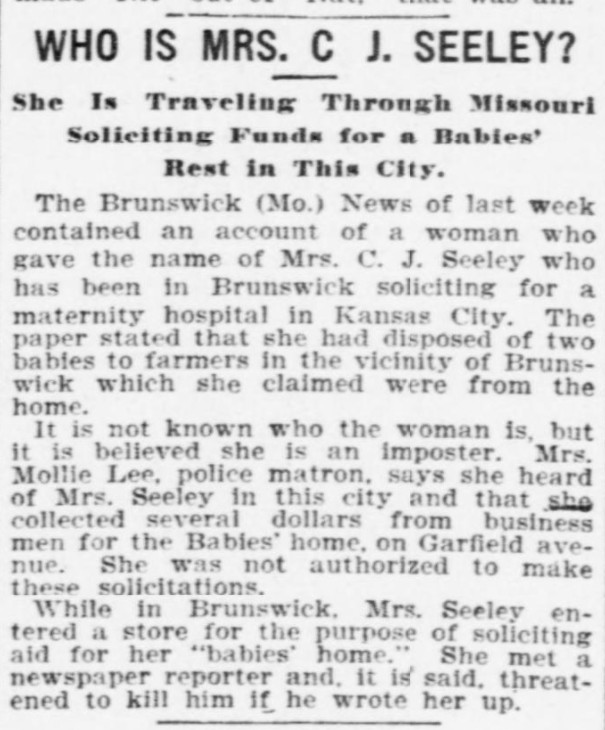
The Journal repeated the Brunswick allegations and reported that Mrs. Seeley had also collected money from Kansas City businessmen for a Babies’ Home on Garfield Avenue. According to police matron Mollie Lee, she had not been authorized to do so.
It added one particularly memorable allegation: while in Brunswick, Mrs. Seeley reportedly threatened to kill a newspaper reporter if he wrote about her.
And then Catherine answered.
“False to the Core”
Five days later, on August 6, the Kansas City Journal published Catherine’s response.
Exactly when—or where—Catherine gave the newspaper her statement isn’t clear from the article. But her answer to the accusations was unequivocal.
The headline read:
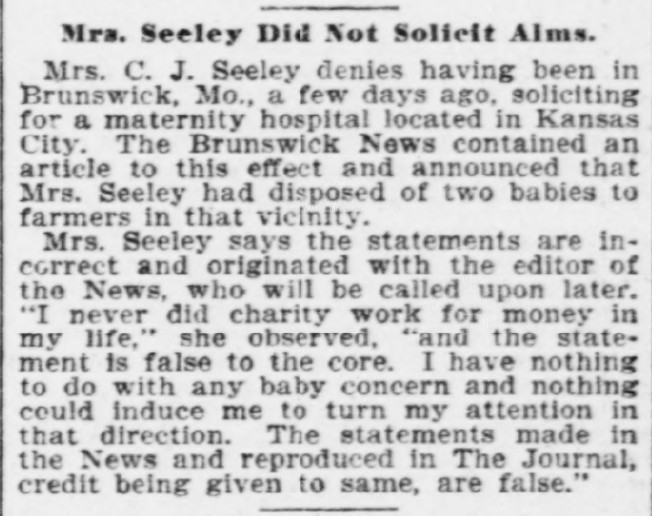
Catherine denied having been in Brunswick soliciting money for a maternity hospital. She denied having anything to do with what she called a “baby concern.” She blamed the editor of the Brunswick News for the story and said he “will be called upon later.”
And then she made a rather remarkable declaration:
“I never did charity work for money in my life.”
She pronounced the story “false to the core.”
There it was: several newspaper accounts, published within days of one another.
An accusation.
More accusations.
And Catherine’s denial.
Which version was true?
That is one of the questions I faced over and over while writing Countess of Cons. Newspapers are extraordinary historical sources, but something appearing in print doesn’t automatically make it fact. Catherine’s denial doesn’t automatically make the accusations false, either.
My job wasn’t to choose whichever version made the better story. It was to follow the evidence—and to be clear about where the historical record ended and narrative reconstruction began.
Fortunately, Catherine’s documented life was colorful enough that I rarely needed to make it any more interesting.
More than a century ago, a newspaper editor asked:
Who is Mrs. C. J. Seeley?
It took me years of research to discover just how complicated the answer would be.
Countess of Cons: The Story of a Gilded Age Grifter
Coming Fall 2026.


Leave a Reply