One of the questions I’m asked most often is:
“How do you know what really happened?”
Take this 1892 courtroom scene from Countess of Cons.
Justice Kersten regarded the woman brought before him—the set of her shoulders too proud for pity, the hands too restless for innocence. Whatever she’d done, she didn’t look like someone who’d stumbled into it.
“Good morning,” he said, addressing the small gathering. “The matter before us is to determine whether sufficient evidence exists to hold Catherine Seeley for trial and to refer the case to the Grand Jury for consideration of an indictment.”
He looked directly at Catherine. She wore a dark wool dress with a tired sheen to the fabric; the velvet collar rubbed thin where it met her throat. A small hat, too decorative for the occasion, shadowed a round, ruddy face gone sallow from indulgence.
“Mrs. Seeley faces fourteen counts, including the unlawful procurement of money under false pretenses. This is not her first appearance before the court. Such conduct shows a disregard for the law and a refusal to seek honest support. If she cannot defend herself, the penalty will be severe—a fine at best, the penitentiary at worst.”
Where did that scene come from?
Not from a single source.
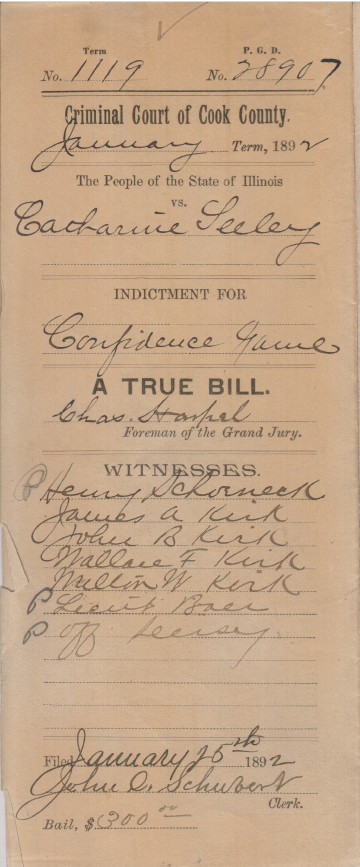
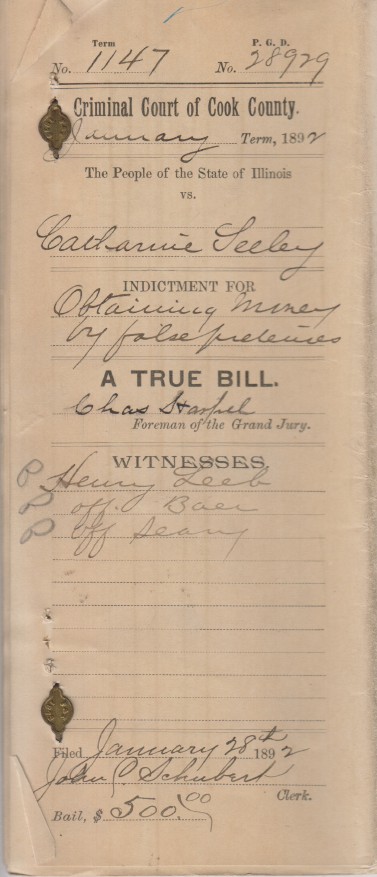
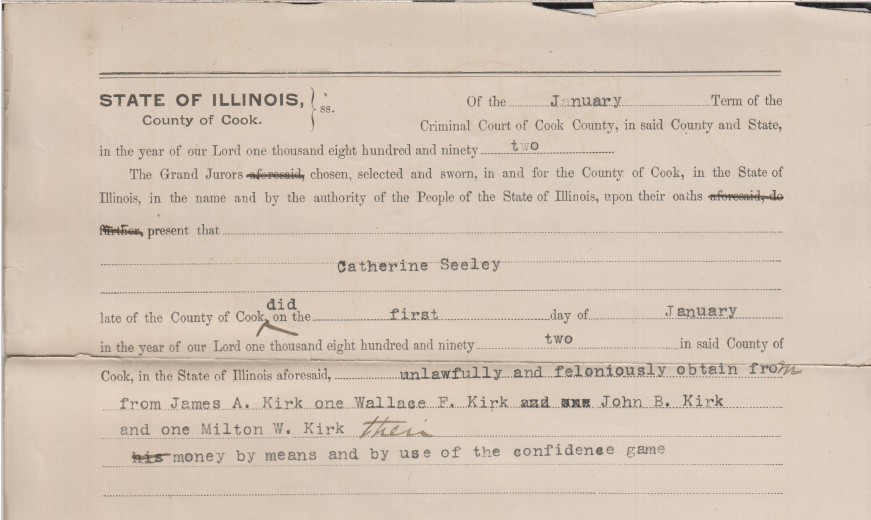
The indictment documents shown below are original Cook County court records copied from the archives during my research. They establish the legal facts: Catherine Seeley was indicted on multiple charges, including obtaining money “by means of the confidence game.”
But those documents tell only part of the story.
To reconstruct the hearing itself, I also relied on contemporary newspaper accounts. Those articles preserved the courtroom exchanges, Catherine’s answers, the judge’s remarks, and even what happened after the hearing ended.
Neither source, by itself, told the whole story.
The court records supplied the legal framework.
The newspapers supplied the human details.
My job as the author was to weave those pieces together into a scene that remained faithful to the historical record while bringing it to life for modern readers.
Moments like this remind me why I love writing historical narrative. Every document contributes another piece of the puzzle until, eventually, the picture begins to emerge.
Behind the Chapter is an occasional series exploring the original documents, photographs, maps, and newspaper accounts that helped bring Countess of Cons to life.
Have you ever come across a historical document that completely changed the way you understood a person or an event? I’d love to hear about it.

 deborahsholman.com
Leave a comment